
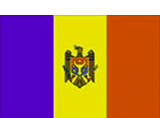
The State flag of the Republic of Moldova is tricolor of equal parts symbolizing the past, present and future of the Moldovan State. The flag is based on the Romanian national flag (although the blue is lighter) and represents Moldova's shared heritage and culture with Romania. In the middle of the flag, the coat of arms consists of an eagle holding an Orthodox Christian cross in its beak and an olive branch in one talon (symbolizing peace), with a scepter in the other (symbolizing strength). On the breast of the eagle is a shield with an aurochs' head surrounded by a crescent, star, and flower. The reverse of the flag does not display any coat of arms being one of only three national flags that differ on their obverse and reverse sides. The others are Paraguay and Saudi Arabia.

 January 1 – New Year's Day January 7 – Christmas January 1 – New Year's Day January 7 – Christmas(Orthodox calendar) March 8– InternationalWomen's Day May 1– Easter (Orthodox) May 1 – International Worker's (Solidarity) Day May 9 – Victory (Memorial) Day June 28 – Constitution Day August 24 – Independence Day |

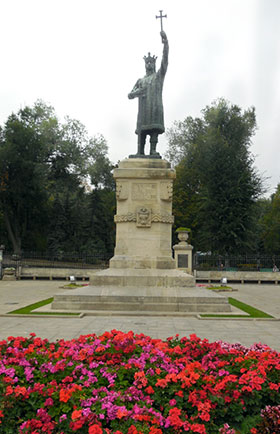
The foundation of Moldavia is attributed to a Vlach nobleman (Dragos) who was ordered by the Hungarian king to establish a defense against the Tatars. Soon afterward, another nobleman (Bogdan I) rejected the authority of the Hungarian Empire and established his own kingdom. The Ottoman (Turkish) Empire was founded in 1453. Stefan the Great (III) was able to maintain independence from the Ottomans during his reign from 1457 to 1503. But in the sixteenth century (1538), Moldavia became a vassal to the Ottoman Empire for three hundred years.
Numerous wars transpired from the sixteenth through the nineteenth centuries for the territory of Moldavia, especially between the Ottomans and the Russians. In 1774, Russia became a protector of Moldavia, still a vassal of the Ottoman Empire.
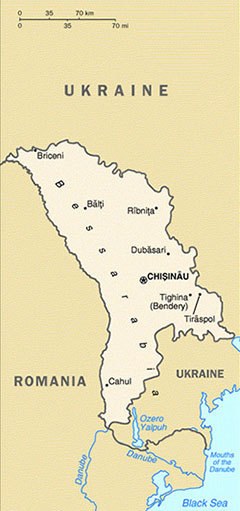
With the notable exception of Transnistria, the territory of today's Republic of Moldova covers most of the historical region of Bessarabia. Until 1812, the term "Bessarabia" referred to the region between the Danube, Dniester, the Black Sea and the Upper Trajan Wall, slightly larger than what today is called Budjak. When the Russo-Turkish Way concluded in 1812, the Treaty of Bucharest between the Ottoman Empire and the Russian Empire allow Russia to annex the eastern half of the Principality of Moldavia. That region was then called Bessarabia.
 Initially, Bessarabia enjoyed a period of local autonomy until 1828. At the end of the Crimean War in 1856, the southern part of Bessarabia (including a part of Budjak) was returned to Moldavia. In 1859, the Principalities of Moldavia and Wallachia united and formed the Romanian United Principalities, a vassal state of the Ottoman Empire.
Moldova declared itself an independent state with the same boundaries as the Moldavian Soviet Socialist Republic in 1991 as part of the dissolution from the Soviet Union. At this time, the Romanian spelling of Moldova was instituted. The new constitution of Moldova was adopted in 1994. A strip of Moldova's internationally recognized territory on the east bank of the Dniester River has been under the de facto control of the breakaway government of Transnistria (Pridnestrovian Moldavian Republic) since 1992.
The territory of Moldova is roughly the size of Maryland. Moldova is a landlocked country with Romania to the west and Ukraine surrounding the other three borders. Moldova's rich soil and temperate continental climate have made the country one of the major suppliers of agricultural products in southeastern Europe, including sugar beets, tobacco and wine. Most of the country is hilly. Moldova's hills are part of the Moldavian Plateau, which geologically originated from the Carpathian Mountains. The largest part of the nation lies between two rivers, the Dniester and the Prut.
 The country is a parliamentary republic. The head of state is the President of Moldova, who is elected by the Moldovan Parliament, which consists of 101 seats. Members are elected every four years. The president of Moldova has been elected by the parliament since 2001, a change designed to decrease executive authority in favor of the legislature. The president appoints a prime minister who functions as the head of government. He assembles a cabinet, both subject to parliamentary approval.
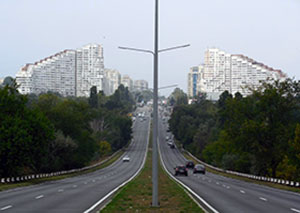
The population is 3,380,000. The capital city is Kishinev (Chisinau). Although the national language of the Republic of Moldova is Moldovan, and its writing is based on the Latin alphabet, the Declaration of Independence in 1991 names the official language as Romanian (based on the Cyrillic alphabet) in the Republic of Moldova and the territory of Transnistria. But linguists have agreed that Moldovan and Romanian are the same or closely related dialects of the same language.
The Moldovan Orthodox Church (autonomous and subordinated to the Russian Orthodox Church) and the Orthodox Church of Bessarabia (autonomous and subordinated to the Romanian Orthodox Church) both claim to be the national church. These Orthodox Churches comprised 95% of the population. About two percent of the population is Protestant. Less than one percent comprises other religious persuasions. Since the dissolving of the Soviet Union, Slavic Missionary Service has been ministering in Moldova, especially in the Trans-Dniester region.

Moldova covers one time zone. The country is seven hours ahead of Eastern Standard Time in the United States.
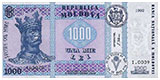
The currency of Moldova is the Moldovan Leu. Twelve Leu equals one dollar.










